Security
Best Placement for Security Cameras: Home and Business Guide
Key Takeaways
- Mount outdoor cameras 8 to 10 feet high for clear facial detail without putting the lens within reach.
- Cover entry points first: front and back doors, the garage, and ground-floor windows.
- Angle cameras from building corners; two walls in one shot closes a blind spot without adding a camera.
- Keep lenses out of direct sun and clear of anything blocking infrared at night.
- Indoors, one ceiling mount at a hallway junction often replaces three wall cameras.
- Commercial sites need coverage at the register, loading dock, and server room, not just the front door.
A camera that can’t see the driveway can’t prove who pulled into it. That’s the real problem with bad placement: the hardware works fine, the footage just doesn’t show anything useful. Four cameras stacked on one porch step and a dark loading dock is a common failure mode, and it looks complete right up until someone needs the footage. Here’s where cameras actually belong, outside and in, and the mistakes that turn good gear into decoration.
Where to Place Outdoor Security Cameras
Start at the entry points. Front doors, back doors, and side gates are where people come and go, which makes them the first places to cover. Driveways and ground-floor windows come next; most break-ins happen through one of those two.
Height matters more than most people think. Mount outdoor cameras 8 to 10 feet up. Lower than that, someone can knock the camera down, spray the lens, or simply reach up and turn it. Higher than that, and facial detail starts to go, which is the one thing a camera is actually for.
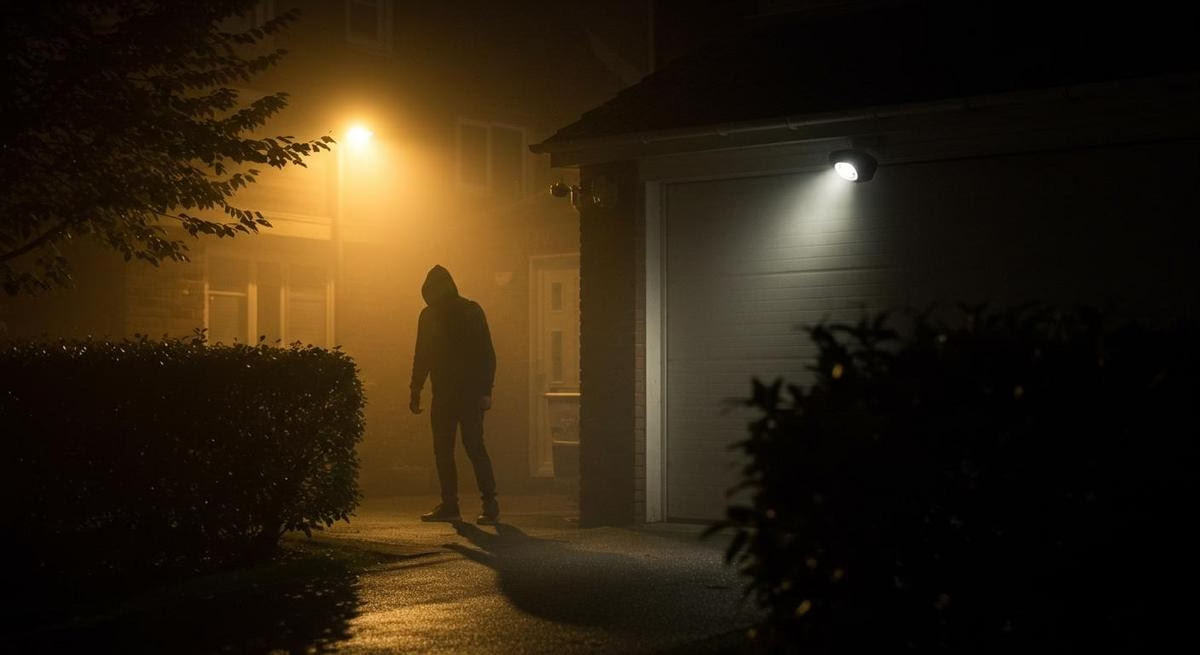
Light is the other variable that wrecks a good setup. Never point a lens into the sun or a light source; it blinds the sensor at the exact moment something is happening. At night, infrared needs a clear path, so a camera aimed past a porch light or reflective siding shows glare instead of a face.
Wide-angle lenses earn their keep over a parking lot or a long driveway, where the job is knowing something moved. For anywhere you need to identify a face or read a plate, a narrower lens beats a wide one; wide-angle trades detail for coverage, and one camera can’t give you both.
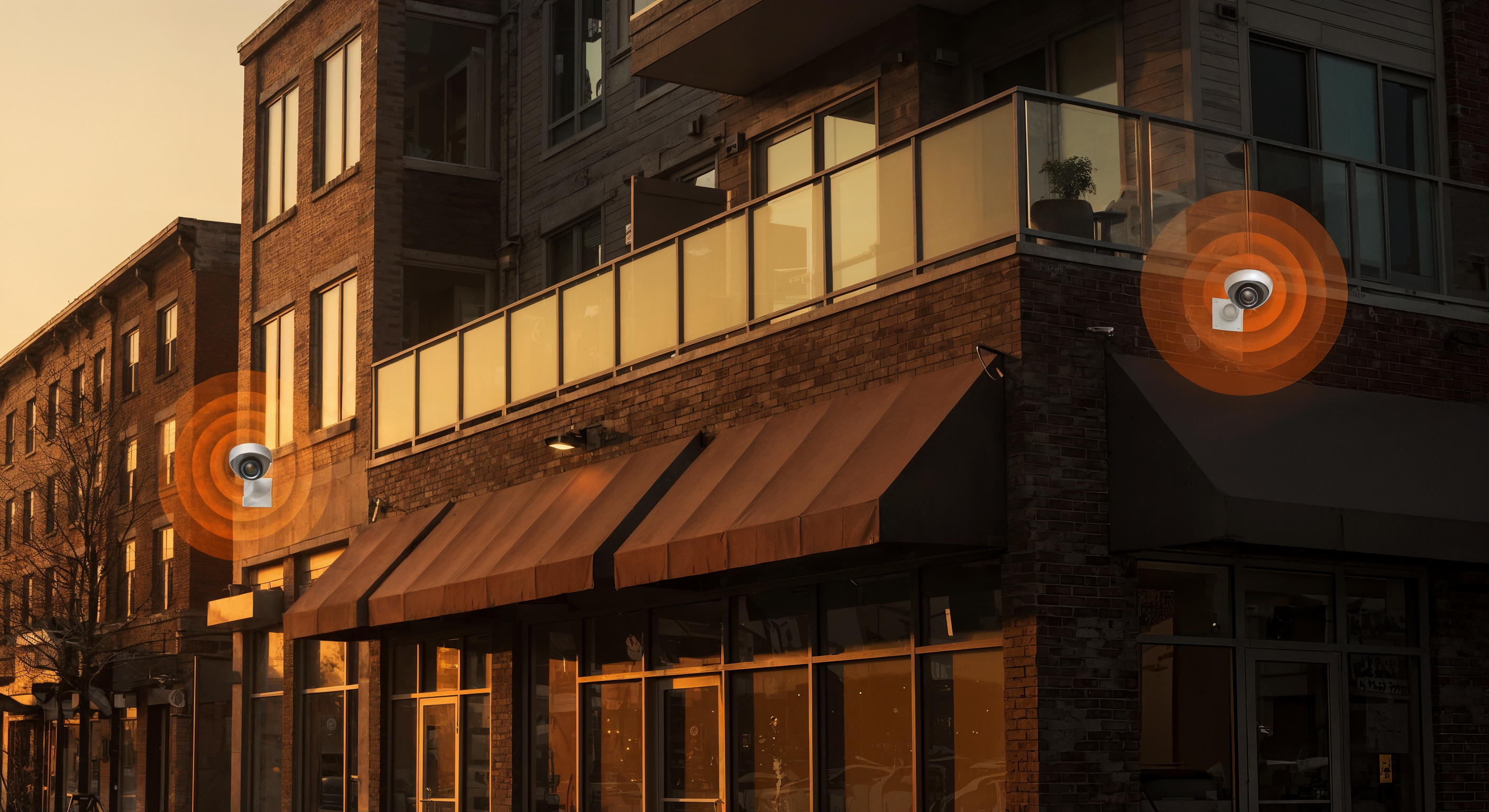
Corners of a building do double duty. A camera mounted on the edge of a wall sees two sides at once, closing a blind spot without adding a second camera. Aim for fields of view that meet at the edges with a small overlap, 10 to 15 percent is plenty. More than that, and you’re paying for a camera to re-record footage another one already caught.
Indoor Camera Placement for Full Coverage
The rule indoors matches the rule outdoors: follow where people actually walk. Entryways, halls, and stairs are the choke points. Cover those, and most of a building is accounted for without a camera in every corner.
Ceiling mounts see a whole room and are harder to tamper with, so they work well at hallway junctions and open floor plans. Wall mounts do better on a direct, close angle, like a single door or a cash register. In a retail space, one camera above the register covers the transaction every time.
Skip cameras aimed at screens, mirrors, or shiny floors; reflections and glare trigger false motion alerts and waste storage on empty footage. Bathrooms, changing rooms, and other spaces where people expect privacy are off the table entirely, both as a matter of trust and, in most jurisdictions, the law.
Securing Entry Points: Doors, Windows, and Garages
The front door gets the most traffic and the most attention, so mount that camera at head height, up to about 7 feet, aimed straight on rather than down from above. A doorbell camera works well here since it catches faces and motion at the angle a visitor actually uses.
Garages are an easy miss. Most garage break-ins happen fast, through a door someone forgot to lock, so one camera inside watching the car and one outside above the door, high enough to catch a face and a plate, closes that gap. Side doors and mudrooms need the same treatment; they’re quiet paths in and easy to forget.
Ground-floor windows and anything near a fire escape deserve a camera too, either mounted outside above the window or positioned across the room facing it. Don’t shoot through the glass from inside; reflections confuse motion detection and ruin night footage. For package theft, a camera facing the porch or delivery drop point, wide-angle if the doorbell camera can’t see that far, keeps the whole exchange on record.
Commercial vs. Residential Placement: What Changes
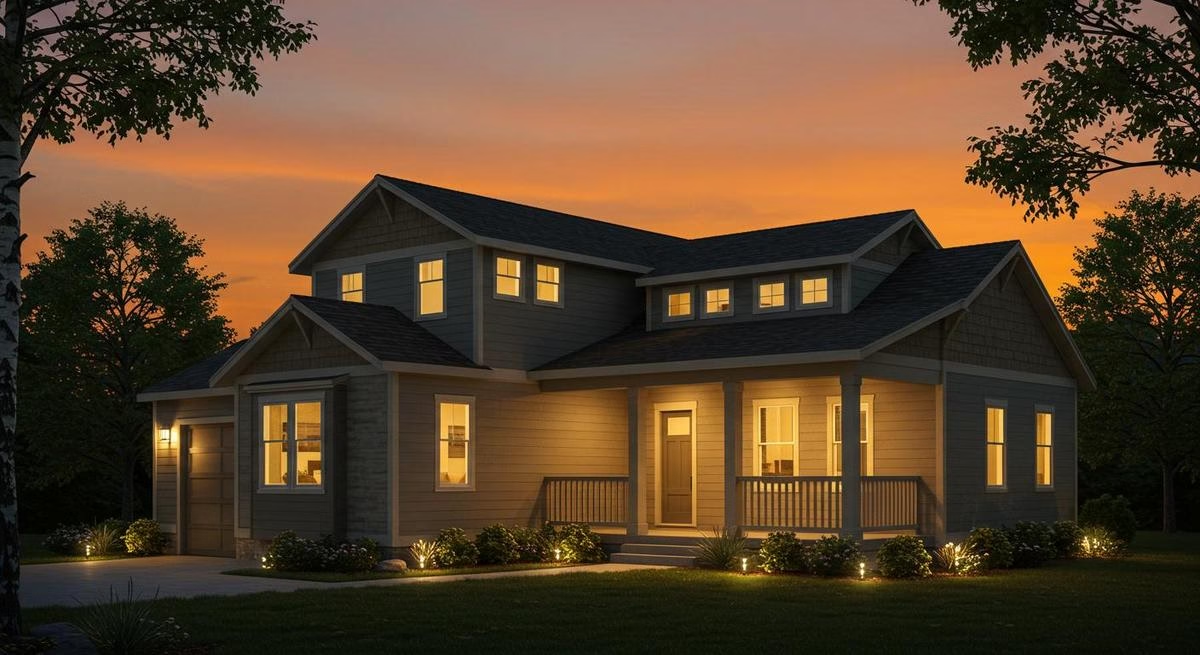
A home needs less than most people assume. Doors, the driveway, and one camera covering the main interior entry usually handle what matters for a family. Two cameras up front, one on the back, and one inside near the entry is a workable baseline for most houses.
A business needs a wider plan. Retail covers the front door, the point of sale, and the aisles, aimed at deterring theft and tracking traffic. Offices need access points, hallways, common areas, and server rooms covered without pointing a lens into break rooms or anywhere staff expect privacy. Warehouses need long-range coverage down aisles, plus loading docks and staging areas, where the most activity and the most risk both happen.
That’s the layout work we do for commercial sites across the Southeast: a walkthrough first, a marked-up plan second, cameras installed third. More cameras isn’t the goal. Full coverage with no dead zones is.
Common Mistakes That Create Blind Spots
A few placement errors turn up again and again:
- Mounting too low, where a camera can be reached, covered, or knocked loose
- Aiming into the sun or a light source, which trades a picture for glare
- Letting bushes, trash bins, or seasonal growth creep into the frame
- Leaving cables exposed instead of running them through a wall or conduit
- Stacking overlap on one door while a side window has no coverage at all
Camera views change even when the camera doesn’t move. Tree limbs grow, the sun’s path shifts with the seasons, a new dumpster gets delivered. Walk the property every few months and check what each camera actually sees, not what it saw on install day.
Placement Is the System
Camera placement isn’t separate from the system itself. A great sensor in the wrong spot produces the same useless clip as a cheap camera in the right one. Get the height, the angle, and the light right, and everything else, from signage to how visible a system reads to someone casing a property, does its job too.
For a commercial property, book a free consultation and we’ll walk the site with you before anything goes on the wall.